
What the teardown showed
I took apart 10 sites in the Estonian online casino affiliate aggregator niche: 105 pages captured, 96 of them substantive, 27 page types, 197 sections, 1,288 tagged elements. The headline finding: the niche looks crowded but rests on a very narrow skeleton — only three of the 27 page types are mandatory, and there is exactly one monetisation section, which is also the only one with 10/10 frequency.
The remaining 24 page types are superstructure. They separate a heavyweight content portal from a thin landing page, but they do not decide whether the site works.
This is the first teardown in a series. I deliberately picked a hard niche: high competition, YMYL subject matter with legal requirements, and an Estonian locale. Further teardowns of other niches and geographies will follow using the same methodology.
How the teardown works
So the numbers below read correctly, a brief note on procedure.
Competitor pages are captured in the et-EE locale with full rendering. Each page is then tagged across three levels: page type → sections within the type → elements within the section. For every element I record its occurrence frequency and one of 4 labels: core of the niche, option, anti-pattern, or my own recommendation beyond what any competitor does. The capture and tagging run on a pipeline I wrote for the task. The same engineering, at-scale approach I unpack in removing watermarks with AI.
Notations like 10/10 or 5/8 throughout this article are that frequency. The denominator counts the sites that have the page type at all, not the whole sample, otherwise rare types would look artificially weak.
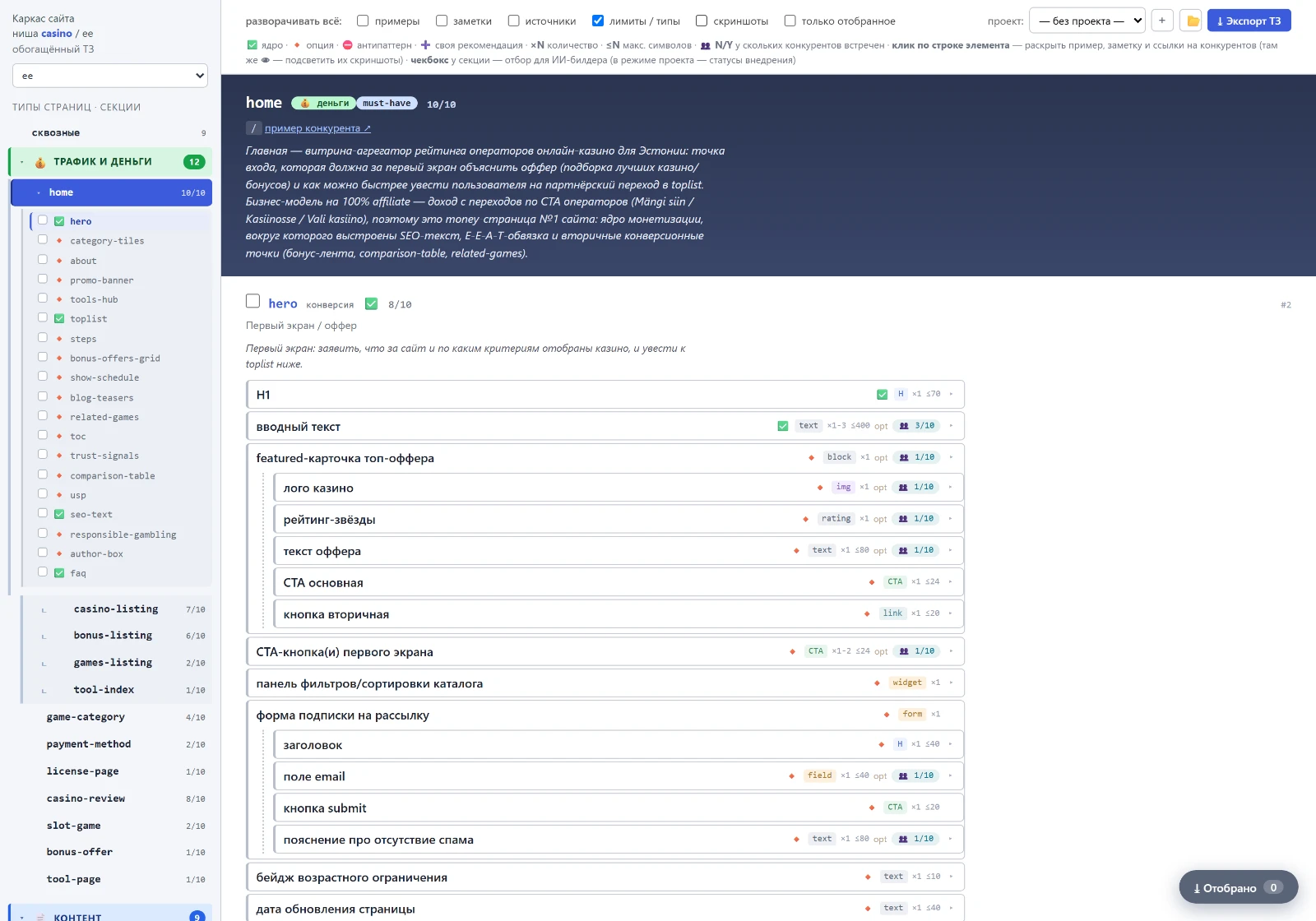
Of the 105 captured pages, 9 had to be excluded: affiliate /go/{slug}/ redirects, broken 404s and programmatic filler. That filtering matters: uniform junk pages skew section frequency toward a template nobody would hold up as an example.
One caveat worth stating up front: this teardown is based on the structure and content of 96 pages, not on competitor traffic data. It answers what they are made of, not what specifically earns them money. Those are two different jobs, and the second needs different tools.
Who is in the niche: 10 competitors and their archetypes
The first thing a teardown gives you: the 10 sites in the sample rest on fundamentally different business models and cannot be compared head-on.
| Domain | Archetype | What sets it apart |
|---|---|---|
| eestikasiino.com | Editorial portal | The most complete: dual E-E-A-T (team grid plus a named article author), a six-stage rating methodology, a thorough responsible gambling block with the statute and real helpline contacts |
| kasiinoinfo.ee | SEO / data-viz giant | The only one with genuine interactive tools: bonus calculator, comparison tool, selection quiz; but zero conversion points inside its educational articles |
| playin.ee | Rich affiliate aggregator | Up to 26 sections on a review, playable slot demos, the only user review form in the niche |
| kasiinomeedia.ee | Media hybrid #1 | An original Twitch show with a broadcast schedule layered on a standard affiliate model |
| win.ee | Media hybrid #2 | An original TV brand with a video episode archive; bonuses pushed below the media content |
| boonuspart.ee | Programmatic, Pay N Play | Dozens of SEO text blocks alternating with the ranking list, one per bonus subtype |
| kiirkasiino.online | Programmatic, narrow niche | Every review built around the single theme of "casinos without registration" |
| tasutakasiino.com | Programmatic, WordPress archive | Game categories implemented as blog archives rather than game catalogues |
| eesti-kasiino.ee | Minimalist landing page | Compact, but the ranking list is duplicated unchanged between sections |
| kasiinod-ee.ee | Low-quality PBN | A single long landing page duplicated under two URLs; footer left untranslated |
This split immediately settles some questions. Once you see that the unique "broadcast schedule" section belongs to a media hybrid, the question "do I need it" answers itself: it follows from a business model with its own streaming channel, not from a requirement of the niche. An empty schedule on a standard affiliate site damages trust more than not having one.
The page type map: only three are mandatory
Twenty-seven page types sounds impressive until you look at the frequency distribution.
| Page type | Frequency | Status | Role |
|---|---|---|---|
home | 10/10 | must-have | Conversion hub: ranking list + E-E-A-T + SEO copy |
casino-review | 8/10 | must-have | Money page #1: one operator, targeting brand intent |
casino-listing | 7/10 | must-have | Ranking hub for many casinos, sometimes filtered |
bonus-listing | 6/10 | recommended | Offer listing by bonus type |
game-category | 4/10 | recommended | Hub for a game category |
blog-category | 3/10 | optional | Blog archive by tag |
about, blog-index, game-guide, games-listing, guide-article, payment-method, slot-game, software-provider | 2/10 | optional | Content and E-E-A-T scaffolding |
author-bio, bonus-offer, contacts, guide-index, license-page, payment-guide, show-schedule, tool-index, tool-page, tv-show-archive | 1/10 | optional | One-off solutions from individual archetypes |
The practical conclusion: the first release of a site in this niche is three page types, not twenty-seven. Anything below 4/10 is either one player's niche experiment or content scaffolding that makes sense once the mandatory core is already pulling traffic.
The long tail at 1/10 is not junk: the most interesting findings in the niche live there, including the interactive tools. But that is phase two, not phase one.
The toplist: the monetisation core of the whole niche
The only section with an absolute 10/10 frequency is the operator ranking list. It appears on practically every page type: the homepage, reviews, listings, game categories, payment method pages, and even inside guides as a mini widget.
The operator card inside that section is split into 14 elements, and the line between working and not working runs like this:
| Card element | Frequency | Comment |
|---|---|---|
| Operator logo | 10/10 | Core, no exceptions |
| Bonus information | 10/10 | One line, or split into "cash" + "free spins" |
| Primary CTA | 10/10 | The affiliate link — this is the monetisation |
| Rating / score | 8/10 | Stars out of 5, points out of 10, or an N/100 scale |
| Link to the brand review | 6/10 | The key internal linking element |
| Advantage bullets | 5/10 | Three or four ticked points |
| Mini attribute table | 3/10 | Min deposit, withdrawal speed, licence: answers questions before the click |
| Rank number | 3/10 | Medallion or badge |
| 21+ / T&Cs disclaimer on the card | 2/10 | Legally significant, yet rare |
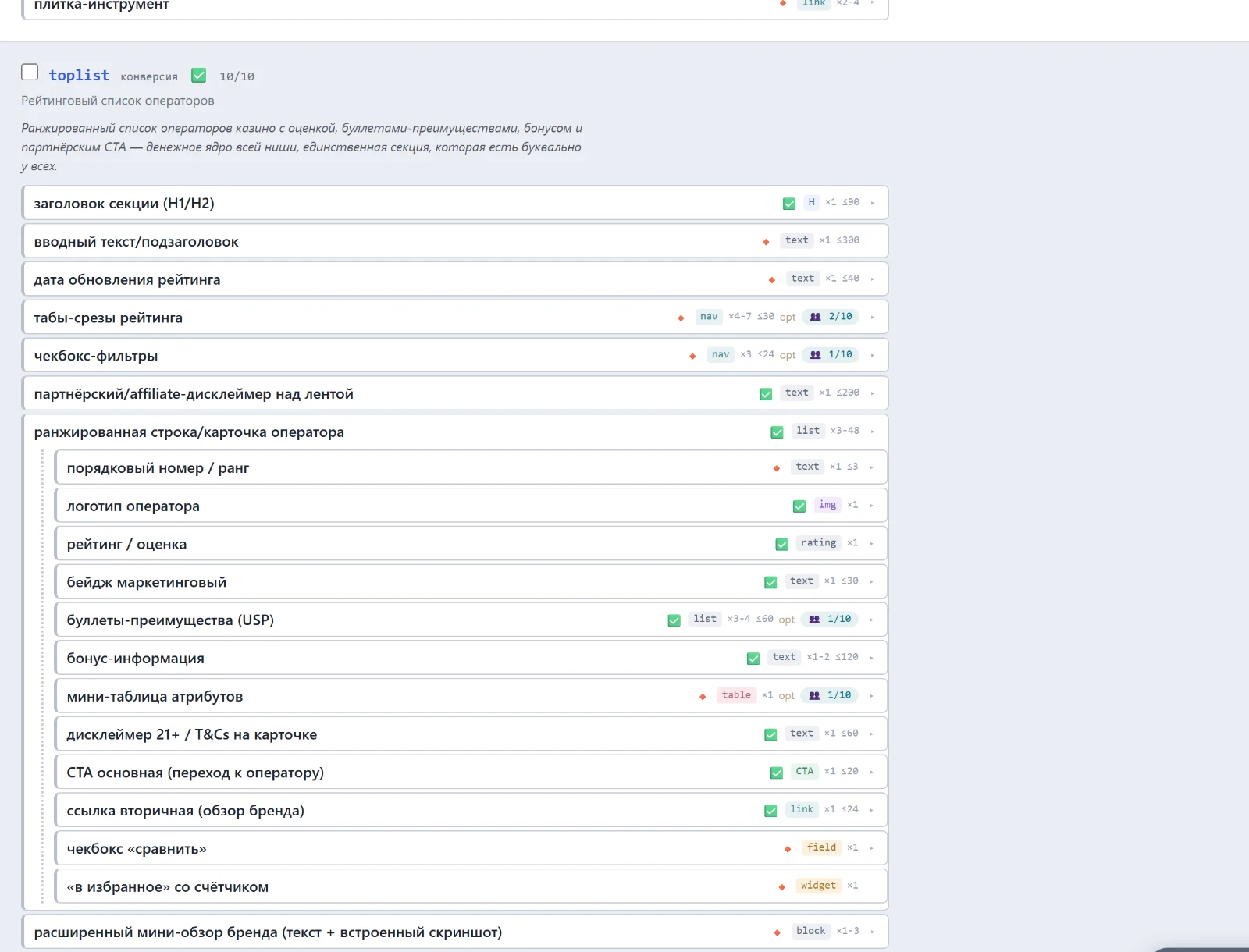
Here is the first telling gap. The 21+ disclaimer directly on the offer card appears on only 2 of 10 sites, and for gambling advertising in Estonia this is not decoration. Frequency among competitors and obligation in substance are different things, and this is one of the cases where following the majority is the wrong move.
Three depth sub-models turned up inside the toplist:
- A single undivided list — seven sites out of ten. Conversion depends entirely on card order.
- Switchable tabbed views of one ranking — eestikasiino.com (7 tabs) and playin.ee (4). The same dataset, different shop windows for different intents: best rated, biggest bonus, wager-free spins, high rollers. Effectively four to seven landing pages without creating separate URLs, and that is the smartest solution in the niche.
- A hybrid of the list with expanded mini-reviews and screenshots — heavier pages, but more depth for top brands.
Anatomy of the money page: a tenfold spread in depth
casino-review is the niche's principal earning page at 8/10 — a single brand review targeting " kasiino arvustus". This is where the quality spread is widest.
At one pole sits boonuspart.ee: 4 sections, not one line of body copy, the entire job compressed into a single brand card. A classic doorway for capturing brand traffic quickly. At the other, eestikasiino.com, where the review is structured as six self-contained sub-reviews each with its own methodology and per-criterion mini tables, and playin.ee at 26 sections counting all nested blocks.
More than a 10-fold difference. The median mandatory skeleton, meanwhile, turned out to be short, 6 blocks in all:
hero (7/8) → casino-info-card (5/8) → specs-table (5/8) → rating-breakdown (5/8) → article-body (7/8) → faq (5/8)
Plus three frequent blocks at 4/8 each: pros-cons, bonus-box and a toplist of alternative brands.
That 6-block skeleton is the answer to "what must be on the page for it to count as complete in this niche". Everything else is growth — worth accommodating architecturally, but not necessarily building on day one.
Ratings in this niche mean nothing
The most telling finding of the teardown. The same brand, Paf, received:
- 5.0 out of 5 on win.ee,
- 96 out of 100 on eestikasiino.com,
- 3.5–4.6 out of 5 on playin.ee and kasiinoinfo.ee.
This is not disagreement about a score — it is the absence of scoring altogether. A user who compares 5.0 out of 5 on win.ee with 96 out of 100 on eestikasiino.com stops believing both.
The worst case is win.ee, where every criterion and the overall score are pinned at exactly 5.0 for both brands analysed, one after the other. The rating stops being a signal and reads as an unfilled template default. This is the rare case where a section does more damage than its absence would.
The only site solving this systematically is eestikasiino.com, with an explicit six-stage methodology signed off by a named editor with a photograph. And playin.ee, which honestly states that a 4.6/5 score is based on 9 reviews, and on another page honestly shows that there is only one. Transparency works better here than the appearance of authority.
36 anti-patterns: what is broken in the niche
This is the part of a teardown people usually skip entirely, and it is close to the most useful. Sites at the top rank despite their bugs, but copying the structure imports the bugs with the skeleton. And if a template travels between markets, the project almost certainly runs several language versions — which adds, on top of the untranslated footer, the question of hreflang setup and common mistakes in the markup, something almost nobody in this niche checks. Thirty-six anti-patterns were tagged in total; these are the most instructive.
Localisation.
- A legal disclaimer and copyright line in the footer in Latvian on an Estonian-language site, across every page type (kasiinod-ee.ee). The template came from another market and was never translated. The same site has Latvian words in the ranking CTA and disclaimer: "REĢISTRĒJIES" instead of Estonian.
- Bonus amounts in dollars ($1,000, $2,000 + 60% rakeback) on a euro-denominated Estonian site (tasutakasiino.com).
- An English-language "How to Play Slots" infographic carrying someone else's watermark on an Estonian site: an unedited stock asset.
Template personalisation bugs. The most dangerous category for any site producing pages brand by brand:
- The "Detailid" card for the WinShark brand contains the support email of a different brand, support@winnerz.com, while the site listed is winshark.com (kiirkasiino.online).
- On the same page, the pros-and-cons block is headed with the other brand's name, and the section body is a bare "|" character.
- An empty cell in the bonus fact table: the "Boonus" field is blank while "Free spins: 110" sits filled beside it. Better to omit a field entirely than to show it empty.
Duplication.
- A verbatim duplicate of the entire ranking section of ~32 cards, twice in a row on the same page (kasiinomeedia.ee).
- An identical offer card repeated twice on the same review page (win.ee).
- A "Toimetaja" (editor) card carrying word-for-word the same biography as the "Autor" card — for the same person (playin.ee). A neighbouring page on the same site has just one card, confirming it is a copy-paste bug rather than a format.
Legal exposure.
- All three consent checkboxes pre-ticked in the subscription form (win.ee). GDPR requires an affirmative act by the user, not the removal of a tick. For an Estonian company that is direct exposure: I have written about how this plays out in the article on the Data Protection Inspectorate precept.
Deceptive UX.
- A deposit form mockup (50 €/100 €/250 € amount buttons, an input field, a checkbox, bank logos) is drawn entirely inside a static image. Users try to click elements that do not exist. Discovering the substitution costs more trust than a plain promotional banner ever would.
- A review showcase where all five pages are 5/5 scores (playin.ee, the Paf page). Systematically positive-only reviews read as filtered and devalue the review function itself.
Cannibalisation.
- The same unfiltered operator list under differently titled pages. The heading promises a selection by payment method; below it sits the identical list of 48 operators from the homepage. The page competes with itself for one intent while its unique content is pushed below 48 cards.
- A giant pillar text of roughly 70 H2s placed directly on the homepage, with no table of contents and not a single repeat CTA (kasiinoinfo.ee). By volume that is several blog articles: it cannibalises the site's own guide pages and dilutes the focus of a money page.
Estonian market specifics
A separate layer of the teardown, the one most often missed when foreign templates get copied: all 6 parameters below hold for Estonia only.
| Parameter | Value for Estonia |
|---|---|
| Age labelling | 21+, not 18+ as in most other markets |
| Regulator | Maksu- ja Tolliamet (MTA); "Litsentseeritud Eestis" is the key trust signal |
| Governing statute | Hasartmänguseadus §55 — the right to stake, period-sum and session-time limits, plus self-exclusion from 6 months to 3 years |
| Helpline | 15410 / 15410.ee, the gambling addiction counselling centre; full self-exclusion via the MTA site |
| Currency | Euro only; an amount in dollars marks an unlocalised template |
| Local payments | Trustly, Brite, Zimpler (Pay N Play), local banks: Swedbank, SEB, LHV, Luminor, Coop Pank, Citadele |
A developed responsible gambling block — with the statute, a self-assessment checklist and real contacts — exists on only one site out of ten. The rest have a token badge or a single "ask for help" line. For a YMYL niche this is not merely a matter of trust but a requirement placed on gambling advertising.
One detail I consider the single best find of the teardown on the honesty front: kiirkasiino.online explicitly warns that the national MTA self-exclusion register does not extend to offshore brands without an Estonian licence. That works against immediate conversion and in favour of trust — a rare combination in this niche.
The local layer, starting with the 21+ label, is the main reason templates cannot be moved between markets mechanically. I see the same thing constantly in ordinary businesses, when a site launches in the wrong language, or in three at once without the resources to sustain them.
What nobody has: 84 points of differentiation
The most valuable column in the final table is not "everyone has it" but "nobody has it". Eighty-four such recommendations accumulated. Tellingly, almost all of them are cheap: this is not "outdo the leader", it is "do the thing everyone forgot".
| Gap | Frequency | What it delivers |
|---|---|---|
| CTA to the top offer in the site header | 0/10 | A conversion point on every page, not only in the hero |
| Repeat CTA every 3–5 sections of long copy | 0/10 | A direct fix for a wall of text with no conversion |
| Trust line (licence / 21+ / verified) above the fold | 0/10 | A trust signal before scrolling, not buried down the page |
| "Data verified on " line in the fact card | 0/8 | A freshness signal costing one line |
| RTP% row with a verification date in the specs table | 0/8 | Critical for YMYL trust |
| FAQPage schema.org markup | 0/8 | A free shot at a rich result |
| An "about the editorial team" block naming the legal entity | 0/10 | Strengthens E-E-A-T more than any disclaimer |
| A mini toplist filtered to the page's own topic | 0/10 | Closes the niche's systemic cannibalisation |
A separate category is the 5 findings that occur on exactly one site and work. They do not belong to the mandatory core, but they show the ceiling of the niche:
- A personal video review by the editor — screen capture of the casino plus the reviewer's face on camera (1/8). The strongest E-E-A-T signal in the sample: it proves first-hand experience better than any amount of text.
- A genuine 1/5 negative review among the positive ones (1/8) — a complaint about excessive wagering requirements, left up and not deleted. It works for trust, not against it.
- Real screenshots of the casino interface in a carousel — lobby, live section, jackpots (2/8). Shows the product as it is before the affiliate click.
- Interactive tools — a bonus value calculator, a three-casino comparison, a selection quiz (1/10). Nearly everyone explains wagering in prose; nobody but one site turns it into an interaction.
- An exclusive promo code for the site's own readers with an expiry date (1/8) — a direct differentiator for the affiliate model.
Note the pattern: the five strongest trust signals in the niche each occur on 1–2 sites out of 8. They are rare not because they are expensive, but because nobody gets around to them. No site in the sample does more than two of the five at once.
What transfers to other niches
The specifics do not transfer: the 21+ label, licensing blocks and responsible gambling belong here alone. But three things show up in every teardown I run.
First: the mandatory core is always narrow. Twenty-seven page types against three mandatory ones is a typical proportion, not a gambling peculiarity. When a client says "we need a site like our competitors have", the conversation is almost always about three or four page types plus content scaffolding that can and should be deferred.
Second: a cross-cutting section must be a component. If a block appears on 5 or more page types, it is one parameterised entity, not five separate builds. That decision is made during web development, not once you have a hundred pages and every fix has to be applied to each of them.
Third: anti-patterns are universal. Empty fields, duplicated blocks, untranslated template fragments, another entity's data in a card — all of it turns up in any niche where pages are produced from a template. The list of 36 bugs found works as an acceptance checklist: half of them are caught in a 5-minute manual check before publishing.
And what the teardown does not give you is worth restating. It shows what the sites at the top are made of, but it does not prove what specifically brings them traffic. A section's frequency only tells you it is the convention in the niche: possibly because it works, possibly because everyone copied everyone. Answering the second question takes query and link analysis — separate work I run alongside this, not instead of it. It is also worth remembering that the top of the results need not match the strongest players in the market at all: when I cross-checked search results against state register data for a price directory built on open data, the largest company in the niche by turnover appeared on none of the first five result pages. Structure removes the reasons a site cannot compete; the reason to prefer you is created by SEO and content.
The data in this teardown is current as of 18 July 2026. The structural conclusions hold for a long time; the specific bugs and offer amounts do not.